The Spark of Life: How Biology is Rewriting the Internet
In recent years, neuroscience has achieved something that sounds like science fiction: restoring movement to people paralyzed by spinal cord injuries. The technique involves a digital bridge — an implant reading signals from the brain's motor cortex, a decoder translating them, and a stimulator below the injury delivering them to the muscles. In one now-famous case, a man who had not moved his hand in months watched his own fingers curl again. The machine did not create anything new. His brain had been sending the signal all along. The implant simply carried the signal across the broken pathway.
To appreciate why this worked — and why it matters far beyond medicine — you need to understand a small, elegant structure that biology perfected hundreds of millions of years ago: the axon.
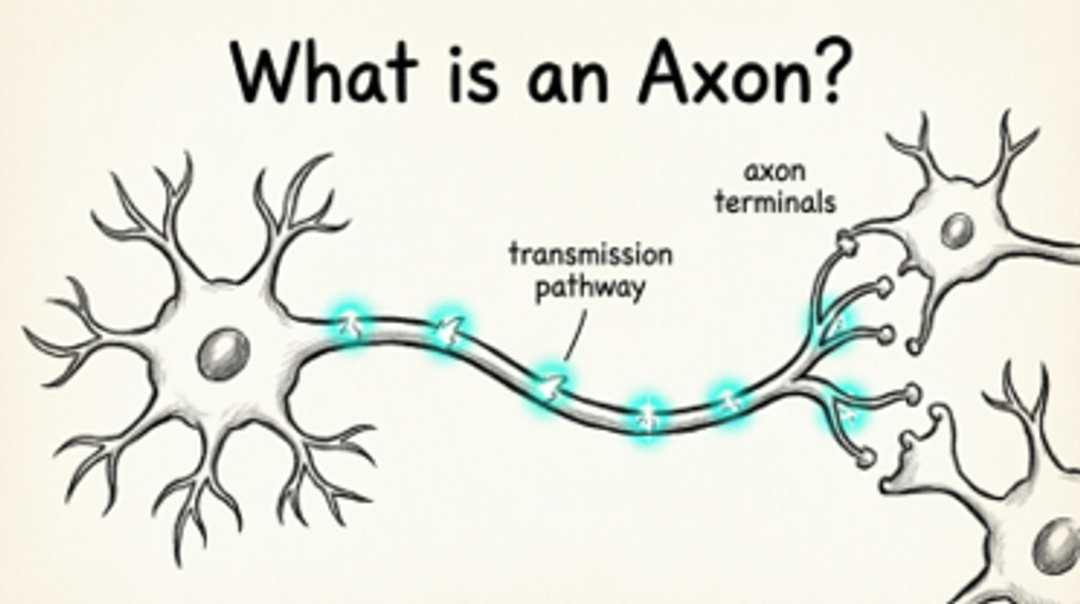
Most people have heard of neurons, the brain's information-processing cells. But neurons are the thinkers, not the doers. The doing belongs to the axon: a long, slender nerve fiber that extends outward from the neuron like a transmission cable, some reaching over a meter in length — the distance from your spine to your toes. The axon's job is singular and vital: carry electrical impulses away from the nerve cell body and deliver them to other neurons, muscles, and glands. Without axons, the brain's brilliance would be trapped in isolation. A thought could not become a word. A decision could not become a step. Every word you have ever spoken and every step you have ever taken crossed an axon first.
Two features make axons extraordinary, and both are worth knowing, because they turn out to be blueprints for how digital networks should work.
The first feature is speed through insulation. The fastest axons are wrapped in myelin, a fatty sheath that acts like insulation on an electrical wire. Instead of the signal crawling the entire length of the fiber, it leaps between small gaps in the myelin — a mechanism called saltatory conduction, from the Latin for "jumping." The result is breathtaking: transmission speeds of up to roughly 120 meters per second. When you catch a cup falling off a table, you are watching information travel the length of your body faster than most data crosses a city.
The second feature is signal regeneration. Neurons fire on an all-or-nothing principle: an impulse either travels at full strength or does not travel at all. At each node along the fiber, the impulse is regenerated — electrically refreshed to its original voltage before continuing. This is why a faint signal from deep in the brain still arrives crisp and unambiguous at a fingertip. The message does not fade on the journey. It is renewed at every step. Integrity is not hoped for; it is engineered into every hop of the pathway.
Now hold those two ideas — fast, insulated transmission and regeneration at every node — and turn them toward a different kind of nervous system: the internet.
The digital world is full of brilliant neurons. Massive servers hold terabytes of research data. AI models represent decades of accumulated intelligence. Research institutions, genome banks, and independent creators generate immense potential every day. But the pathways between them — the axons of the digital world — are broken. Corporate firewalls block the signal. Paywalls wall off journals. Databases use incompatible formats and cannot exchange information. APIs that researchers depend on vanish when a startup is acquired. The result is a kind of paralysis that looks eerily like the spinal cord injury we started with: intelligence on one side of the gap, need on the other, and no working connection between them.
Data becomes trapped. Innovation slows. Value accumulates in isolated systems instead of flowing to where it could create impact. The internet, in other words, has the condition — brilliance everywhere, transmission nowhere.
This is the biological parallel that gave Axons Protocol its name. In the body, axons transmit impulses securely and instantly, regenerating the signal at every node. Axons Protocol builds the digital equivalent: a decentralized network where nodes act as digital axons, carrying data and value across the internet's broken pathways.
The mechanics map onto the biology with surprising precision. Every piece of data transmitted through the network travels with a cryptographic signature and a hash — a unique digital fingerprint computed from the data's exact contents. At every hop along the route, the receiving node verifies that fingerprint before passing the data onward, exactly the way a nerve impulse is regenerated at every node along an axon. If even a single bit has been corrupted or tampered with anywhere along the journey, the fingerprint no longer matches, and the network detects it immediately. Nothing degrades silently. Nothing arrives altered without detection. Integrity is not promised; it is checked at every step, by mathematics.
Then comes the second parallel: synapses. In the body, when an impulse successfully crosses from one neuron to the next, chemistry delivers the consequences — neurotransmitters carry the signal forward. In Axons Protocol, that role belongs to smart contracts: self-executing programs that spring into action when a verified delivery occurs. The moment data arrives intact and confirmed, the contract automatically releases what the transmission has earned — payment to the nodes that carried it, attribution to the researchers who created it, access rights to the party that requested it. No intermediary decides whether the signal deserves to pass. The conditions are met, and the network responds, automatically and transparently.
Just as a neural implant bridges the gap in an injured spine, Axons Protocol bridges the gap between siloed databases — allowing data to flow, connect, verify itself, and trigger meaningful action along the way.
Because this is what biology settled billions of years ago: intelligence alone is not enough. A nervous system is not a brain floating in a jar. It is a brain wired to a body, with axons carrying thought into action. The internet's problem has never been a shortage of intelligence — it is a shortage of connection. And connection is what turns potential into progress.
The man who watched his fingers curl again did not get new intelligence that day. He got a pathway. The scientific world is waiting for the same thing.