The Grant Writing Treadmill: Why Scientists Need a Way Out
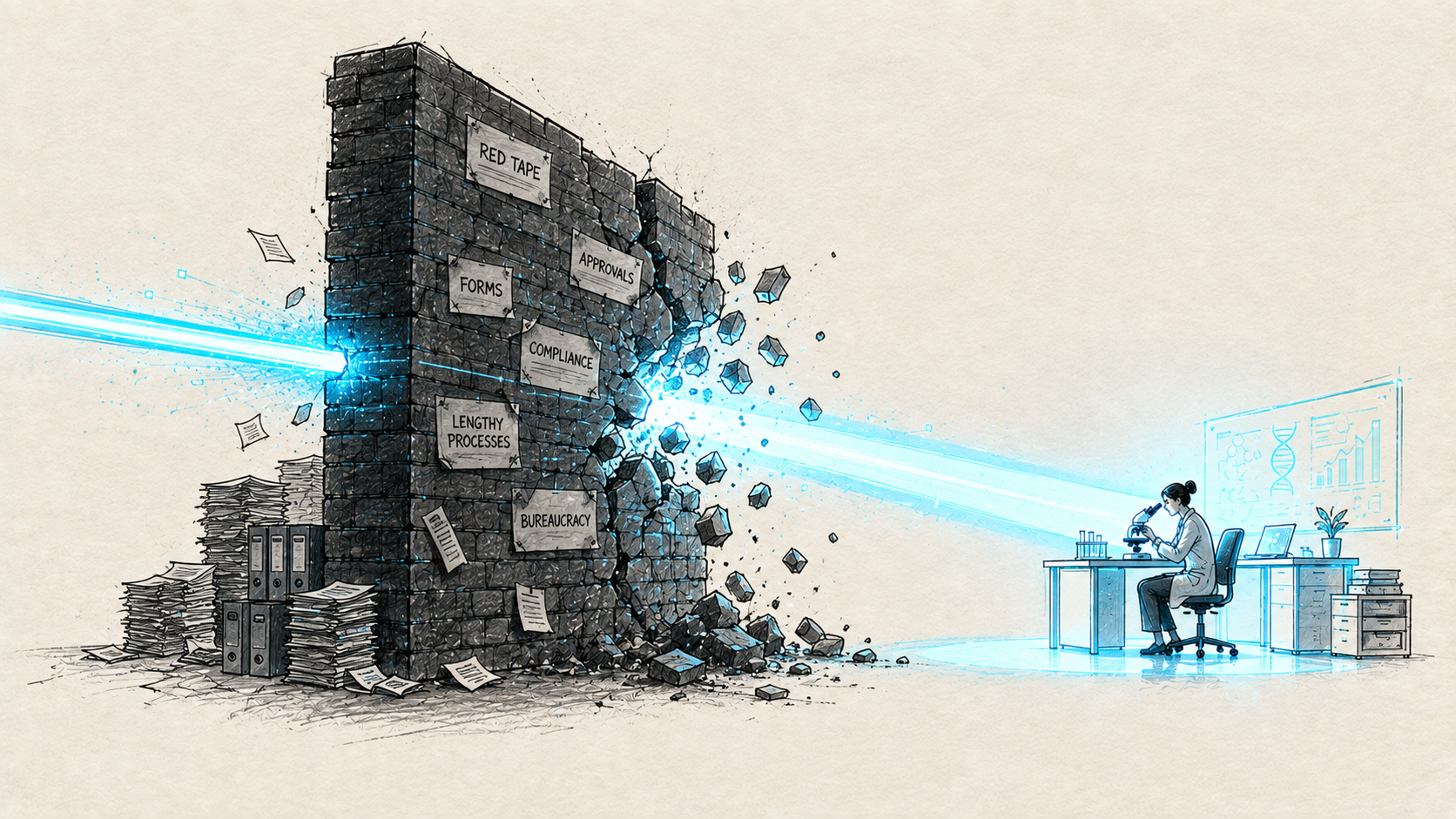
Ask a working scientist how they spend most of their time, and the honest answer is rarely "doing science." Across academic surveys and time-use studies, a striking pattern repeats: senior researchers commonly report spending the majority of their working hours — often estimated at 70% or more — not running experiments, not analyzing data, not mentoring, but writing grant applications. The people trained to ask the hardest questions in the world spend their careers becoming experts in a different skill entirely: persuading a small number of funding bodies, through lengthy and highly formatted documents, to release money.
The scale of the effort is remarkable. A single major federal proposal can consume 200 or more hours across several months: a research strategy refined through dozens of drafts, preliminary data assembled like a courtroom exhibit, and a budget justified down to the cost of laboratory consumables. Multiply that by the number of applications a lab must submit each year to keep the lights on, and the arithmetic becomes sobering.
Now add the odds. The rejection rate for major scientific grants hovers around 80%. Eighty percent. That figure means that most brilliant ideas, years of preparation, and millions of dollars in collective researcher time simply evaporate before a single experiment begins. It is worth pausing on what that really represents: not a few disappointments, but a systematic incineration of scientific potential, repeated every funding cycle, in every country.
To understand why, it helps to look at how the system makes decisions. Every year, governments and major foundations allocate a finite pool of research capital. Thousands of scientists compete. A small number of reviewers — typically unpaid, overworked, and drawn from the same small community of specialists — score the proposals, and a payline divides the funded from the unfunded. The structure has predictable consequences.
The first consequence is conservatism. Reviewers are accountable for the money they award, and the safest recommendation is always the proposal that resembles work that has already succeeded. Genuinely novel ideas — the ones that reopen entire fields — are, by definition, the hardest to score, because there is no prior result to reassure the reviewer. The system is structurally biased against exactly the kind of thinking it claims to prize.
The second consequence is incoherence. Because proposals are judged by a handful of individuals, outcomes can hinge on contradictory tastes. It is not unusual for one reviewer to reject a proposal as "overly ambitious in scope" while a second rejects the same document pages later as "insufficiently innovative — an incremental approach." Both criticisms cannot be true at once, yet either is sufficient to kill the project. Two strangers, in different cities, can end a laboratory's future in sentences that contradict each other.
The third consequence is systematic neglect of small populations. Review committees think in aggregate impact: a project serving millions scores well; a project serving a small group scores poorly. This is precisely why research into rare diseases — individually affecting a few hundred people — is chronically underfunded, even when the science is excellent and a cheap diagnostic or therapy is within reach. Two hundred children, measured by a scoring rubric, are a rounding error.
And the hidden costs extend far beyond rejected proposals. Lost momentum. Delayed experiments. Paused discoveries. Teams that shrink — technicians and post-docs whose employment is tied to grant cycles, dismissed not because the science failed but because the paperwork did not impress a committee. Ideas that never leave the whiteboard. And a slower, quieter erosion: each generation of scientists watches innovation stall long before the experiment begins, and draws conclusions about whether the system is worth staying in.
So it is worth asking the question the treadmill never lets anyone ask: what if funding looked different?
This is where decentralized infrastructure — the kind being built by protocols like Axons — changes the equation. The alternative is direct, community-driven funding, and its mechanics are worth understanding in detail, because they solve the specific failures above.
A researcher tokenizes their project: the proposal, the milestones, and the budget are published on-chain, visible to anyone, anywhere. Instead of asking a faceless bureaucracy for $500,000, the researcher opens the work to thousands of people who micro-fund the research they care about — twenty dollars at a time, from a global audience. And the arithmetic of attention flips. A review committee sees two hundred patients and deprioritizes them. A protocol sees two hundred families, their extended networks, and the rare-disease communities that organize online — and fifty thousand people contributing twenty dollars each is a fully funded laboratory. The people with the most skin in the game finally have skin in the game. Conservatism stops mattering, because there is no committee to play it safe on behalf of.
The money also moves differently. Funds release in tranches as pre-registered milestones are verified, with progress visible to every contributor. If a milestone genuinely fails, the remaining funds return to the community — and the negative result is still published, timestamped, and citable. A well-run failure becomes information the current system never captures.
Then the loop closes in a way the grant system never manages. Once the research is complete and the data is shared on the protocol, the researcher is rewarded directly by the network: query fees when others use the dataset, attribution on every downstream discovery, ongoing revenue from the value the work creates. Funding stops being a subscription renewed by groveling and becomes an investment that returns.
None of this abolishes institutions, and it does not abolish rigor. It removes the friction between good ideas and the resources needed to test them — and it reassigns the decision to the people who live with the outcomes.
The question is not whether science needs funding. Of course it does. The question is whether funding should evolve alongside science — or keep demanding that the world's best minds spend half their careers asking permission.
The treadmill can be switched off. The infrastructure to do it exists.