The Locked Vault: How Data Silos Are Suffocating Innovation
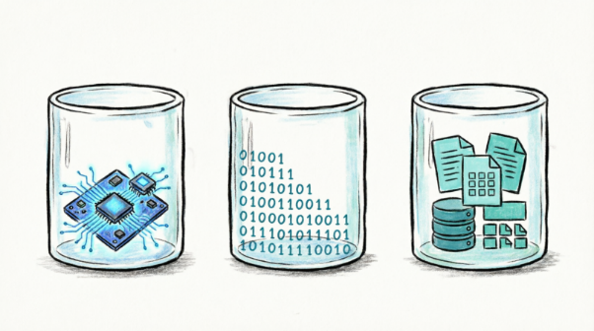
You stare at the blinking cursor on your monitor while the low hum of the laboratory air conditioning does nothing to soften the frustration building in the room.
For three years, you’ve been mapping the genomic markers of a rare neurodegenerative disease. You’re close—tantalizingly close—to identifying a viable enzyme replacement therapy.But now you’ve hit a wall and you know the missing piece exists.Two years ago, a pharmaceuticals company published a paper that hinted at the exact genetic sequence you need. The breakthrough is out there. You can see its outline, so you submit a request to access the underlying data. The response arrives. A polite, corporate “no.”
The data remains locked inside a proprietary silo—protected by legal agreements, competitive positioning, and closed systems. It isn’t available to the scientific community. It sits unused, stored away like a treasure locked in a vault.
And now your work slows.
Not because the science failed.
Not because the technology doesn’t exist.
But because access was denied.
Every day, millions of researchers, AI developers, and independent scientists face some version of this reality.
We live in an age of unprecedented information abundance, yet innovation often moves as though knowledge were scarce.
Imagine a vast city suffering through drought while a full reservoir sits behind locked gates. Enormous volumes of valuable data flow in—patient records, climate models, genomic sequences—but very little flows back out into discovery, collaboration, or progress.
This is the Data Silo Problem.
It is one of the defining bottlenecks of the modern digital era.
Data, by its nature, becomes more valuable when it can be connected, compared, and built upon. When data is trapped inside isolated systems, it loses context—and with it, much of its potential.
An AI model attempting to detect early-stage cancer cannot reach its full capability if it only learns from one demographic stored inside one institution’s servers.
So instead of advancing, you spend years recreating information that already exists somewhere else.
The breakthrough is delayed.
Not because humanity lacks intelligence.
But because knowledge cannot move.
We are investing billions into generating data—only to lock it away.
But what if the gates could open?
What if data could move securely, transparently, and equitably to the people who could transform it into discovery?
What could we build then?